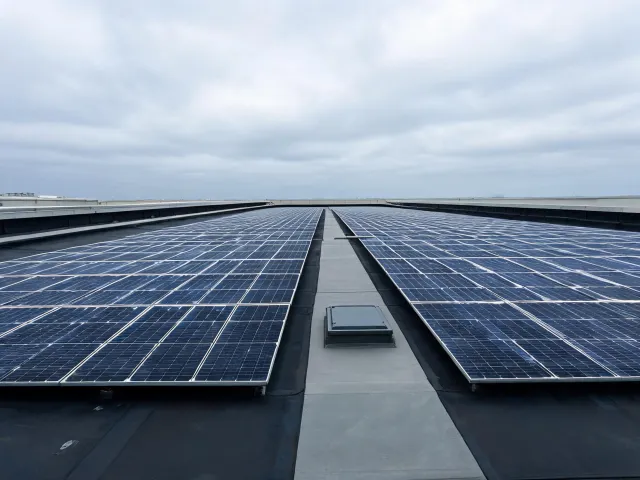
Commercial rooftop
Record roof zones, setbacks, and whether the buyer is purchasing modules separately from racking. The RFQ unit is usually modules or pallets.
Independent sourcing partner
SolarSource Sourcing helps EPC procurement teams, solar installers, and equipment distributors ask solar panel manufacturers for factory quotations after the module family, electrical interface, quantity, and US destination are written down. The desk does not stock modules and does not treat a family brochure as proof for a named model.
A usable brief names rated power in watts, module efficiency with its test basis, cell technology, outline dimensions, connector family, and maximum system voltage. Open-circuit voltage and maximum power voltage stay on the datasheet request so a later inverter match is not guessed from the watt label.

Related paths: commercial solar panel rows, supplier document review, and the procurement brief note.
The DOE solar photovoltaic system design overview, accessed on 2026-10-26, frames questions about system components; it is not a product approval. Ask each proposed supplier for the current datasheet and dimensional drawing of the quoted model. Where the project needs them, also ask for applicable safety-listing and qualification-test records tied to that model, warranty text, and packing drawings.
A family brochure does not identify string current, connector gender, or frame grounding holes for the unit that will ship. These items stay unresolved until a named supplier answers them:
Structural checks, interconnection, and safe installation remain with qualified parties. This desk coordinates documents and quotations.
Hypothetical RFQ example, not a customer record or equipment recommendation: 4,800 modules at a requested 550 W each give a 2.64 MW nameplate total before a separate 96-module spare line. A requested 1500 V maximum system voltage remains subject to exact-model confirmation and project engineering. Record the connector and outline drawing as open until the proposed supplier supplies matching files; the comparison remains incomplete until those answers are reviewed.
Record roof zones, setbacks, and whether the buyer is purchasing modules separately from racking. The RFQ unit is usually modules or pallets.

State row length and whether trackers are a different purchase. Keep megawatt totals from hiding a spare-module line.
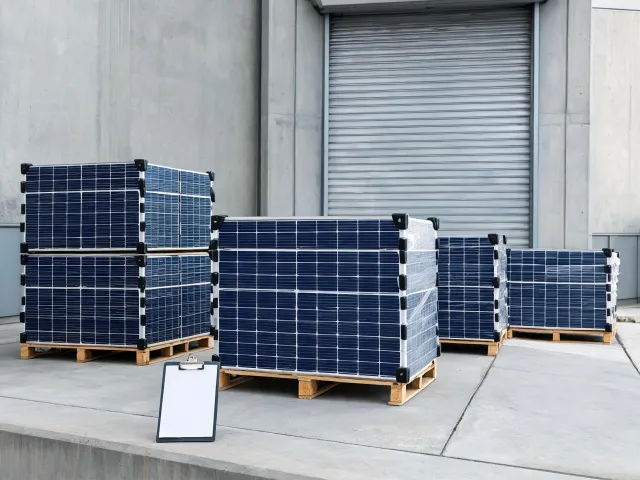
Ask how many modules sit on a pallet and which connector is bagged separately. Destination labor changes the delivered scope.

Buyers often compare nameplate watts and then discover open-circuit voltage differs. Put both numbers on the request.
Write rooftop, ground-mount, or a distributed site, plus the interconnection voltage the engineer already expects. A watt class without the application leaves cell technology and frame size open.
One side of this tradeoff treats the lowest unit price as useful when accessories, freight, and documents truly match. The other side compares delivered scope, because a missing connector, a different Incoterm, or a brochure in place of a model datasheet changes the award. SolarSource Sourcing lines the quotations up; it does not publish a savings figure.
We do not stamp drawings, predict energy yield, or claim a safety listing. MPPT behavior and DC-to-AC ratio belong to the inverter and array design, which should be a separate confirmation if those products are purchased together.
Use modules, pallets, or MW, and name the US city or port. Add the requested delivery window as a buyer target. A supplier date in a draft quote is not a commitment from this desk.
Datasheet, drawing, and any UL or IEC file should name the quoted model. A product-family PDF that omits the model code stays in the unresolved column.
An optional budget needs a currency and a per-module or whole-order basis. High-end, mid-range, budget, or not yet decided is a buyer preference. It is not a verified tier and it is not a finished price.
Tell the desk the specification, quantity, destination, and timing. Optional budget and supplier preference can travel with the same note. Factory quotes come back for comparison; inventory and listing status are confirmed on the proposed item.
Open the full contact page if you want the step list beside the form.
Sourcing coordination
Eligible coordination may reach up to 3%.
Eligibility applies to qualified business buyers and is confirmed after we review your product, quantity, destination, and sourcing requirements.